FIELD NOTES · NASA BLUE MARBLE 2004
What colour is Earth?
There is no single colour that describes every view of our planet. The answer depends on what you include, when you look, and how you combine the colours.
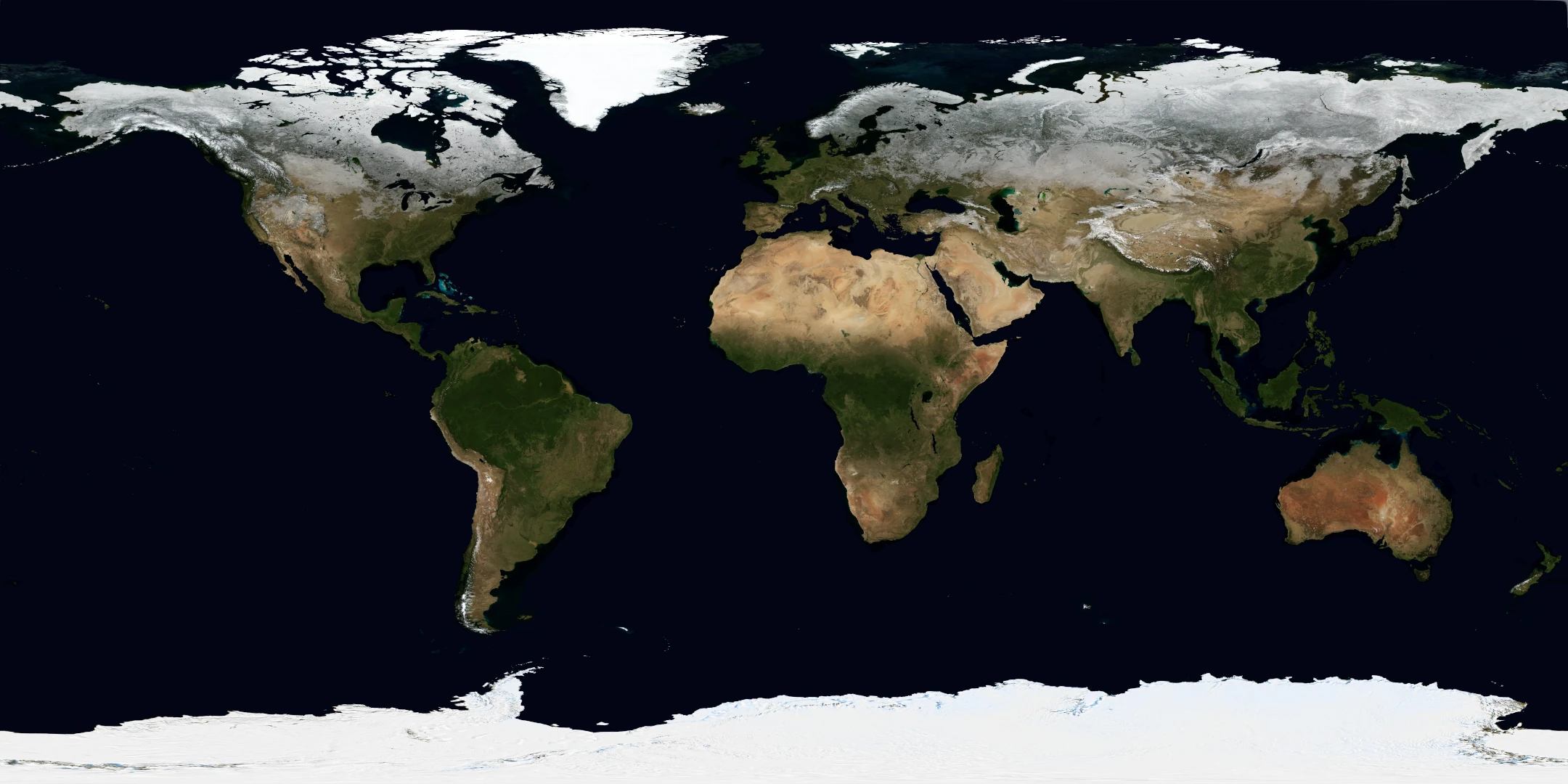
A blue planet, a varied surface
In this map, the dark oceans sit beside the browns of deserts, greens of forests and bright tones of snow and ice. A colour taken from any one place cannot represent all the others. Even a single location has different values across the twelve available months.
Average Earth lets you investigate those differences rather than assigning one universal hex code to the planet. Open the world colour map and choose a location to see the colour of its grid cell.
Land only or the whole image?
The atlas offers two scopes. Land only uses a coarse land-fraction mask to weight the averages. Whole image includes rendered ocean pixels as well. Changing the scope changes the question being asked, so it can change the answer substantially.
The global swatch is an area-weighted image average. It is not the colour you would necessarily see from a spacecraft: this map uses a flat projection and processed composites, with no viewing angle or atmosphere model.
Why averaging colours takes care
A flat latitude–longitude map gives polar grid cells more visual space relative to their real area. Our global and longitude averages account for cell area, so a polar cell does not count as much as an equally wide cell near the equator. We also average in linear light before converting the result back to display RGB.
That makes the calculation consistent, but does not turn a display image into a scientific reflectance measurement. Read the method and data limitations before interpreting the values.
Try a small colour study
- Choose a point in the Sahara and note its hex code.
- Move to the Amazon and compare the hue.
- Keep a northern location pinned and switch between January and July.
- Compare Land only and Whole image to see how scope affects the global average.
Use the monthly colour guide to explore that last comparison in more detail.
Find a place’s colour ↗